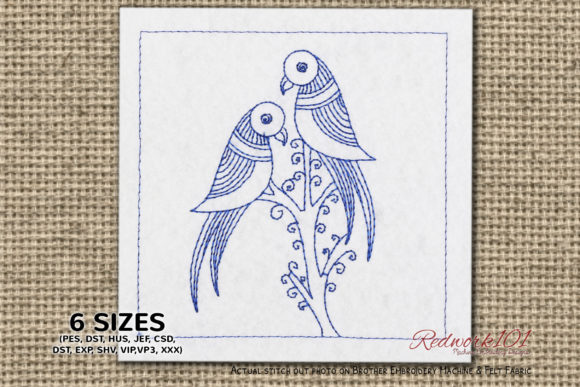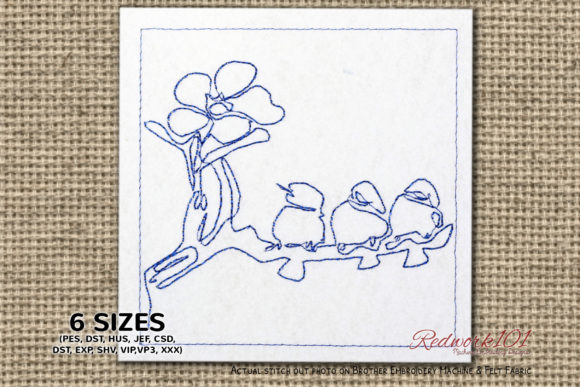
Three Little Birds on Tree Redwork
A Delicate, Timeless Redwork Charm for Boutique Apparel
As an embroidery designer who’s stitched thousands of boutique collections—from seasonal sweatshirts to limited-run denim jackets—I opened Three Little Birds on Tree Redwork expecting charm. What I found was something more: a quiet confidence in its simplicity. This isn’t a loud, trend-chasing motif—it’s redwork at its most intentional. The three birds perch with gentle asymmetry on a slender branch, their forms defined by clean satin and stem stitches rather than dense fill. There’s no heavy outlining or excessive detail—just confident line work, balanced negative space, and a subtle narrative warmth. It reads as classic, not dated; rustic, not rough; feminine without frills. For small clothing brands building a cohesive visual language, Three Little Birds on Tree Redwork delivers instant personality without demanding attention.
How It Performs Across Real Apparel Projects
On neutral heather gray sweatshirts? Exceptional. The redwork thread pops just enough against the muted base—no glare, no washout. On pastel hoodies (think blush, sage, or sky blue), it gains softness and approachability, ideal for spring capsule collections. Over dark garments—navy fleece, charcoal French terry—the design holds clarity when paired with high-contrast thread, though I recommend testing stitch density first to avoid shadowing in dense areas like the branch junction.
For chest placement on oversized hoodies, Three Little Birds on Tree Redwork scales beautifully—it’s compact enough to sit cleanly above the pocket but detailed enough to read from three feet away. As a sleeve accent on t-shirts or lightweight knits, it adds artisanal flair without bulk. On denim jackets, it leans into vintage Americana; on linen-blend totes, it whispers handmade luxury. And for cozy seasonal layers—cable-knit cardigans or brushed cotton joggers—it brings a grounded, nature-connected calm that resonates with lifestyle branding.
Smart Placement & Fabric Considerations
This design shines in small-to-mid chest placements (3–4 inches wide), where its balance and proportion feel intentional—not cramped or lost. Avoid placing it over highly curved surfaces like shoulder seams or deep ribbed cuffs unless you’ve tested stabilizer hold. On stretchy fabrics (e.g., cotton-spandex blends), use a light cutaway or tear-away + topping combo to prevent bird beaks or branch ends from distorting during hooping or wear.
Fleece and heavy French terry benefit from reduced stitch density in the branch area—check the file’s fill regions before running full production. If your version includes the optional Box Stitch (as noted in the Creative Fabrica description), treat it as a framing device—not part of the core motif—unless your brand consistently uses border elements. When it’s part of the design itself, it anchors the composition; when applied separately, it risks feeling tacked-on.
Where It Adds Quiet Value
- Apparel value: Elevates basic garments into signature pieces—especially effective for “slow fashion” positioning or gift-ready bundles.
- Brand identity: Reinforces authenticity and craft focus. Customers associate thoughtful redwork with care and intention—not mass production.
- Buyer trust: Clean, well-digitized redwork signals technical competence. No floating threads, jagged edges, or inconsistent stitch direction.
- Product recognition: Distinctive yet versatile—fans begin to recognize it across your hoodie line, tote collection, and Instagram flat lays.
- Visual consistency: Works seamlessly alongside other Birds-category designs on Creative Fabrica if you’re building a nature-themed series—but stands strongly alone.
Practical Designer Notes Before You Stitch
Always test Three Little Birds on Tree Redwork on scrap fabric pulled from the exact garment batch you’ll use. Fleece from Vendor A behaves differently than fleece from Vendor B—even with identical specs. Confirm stabilizer choice: lightweight cutaway for stable knits, fusible + tear-away for wovens like chambray or denim.
Review thread color contrast carefully—redwork traditionally uses matte rayon or cotton, but some modern machines handle polyester better on high-pile fabrics. Inspect stitch density in the birds’ bodies and branch intersections: tight fills can cause puckering on delicate knits. Confirm hoop size compatibility—this design fits comfortably in a 4×4 hoop, but double-check your file’s actual dimensions before nesting multiple units.
Compare placement options visually: center-chest, left-chest, sleeve cuff, or back yoke. Use printable mockups to preview how Three Little Birds on Tree Redwork lands in lifestyle product photos—natural light, relaxed folds, and soft shadows make it breathe. For Etsy listings, pair it with warm, minimal captions (“Hand-embroidered redwork • Small-batch apparel • Designed for slow living”)—not keyword stuffing.
Lastly, review Creative Fabrica’s licensing details thoroughly. As a commercial embroidery designer, I never assume usage rights—especially for digital embroidery files intended for resale as finished product. Clarify whether the license covers unlimited physical items, digital resale of stitched goods, or social media promotion. Your reputation—and your small shop’s compliance—depends on it.
Final Thought: A Design That Grows With Your Brand
Three Little Birds on Tree Redwork doesn’t shout. It settles in—on a cream hoodie at dawn, on a denim jacket tossed over a café chair, on a tote bag held by someone scrolling through your Etsy shop. It’s the kind of Creative Fabrica embroidery that supports storytelling instead of interrupting it. For apparel decorators, Etsy sellers, and boutique brands building real connection—not just inventory—it’s not just another bird motif. It’s a quiet signature, ready to become part of your visual vocabulary.