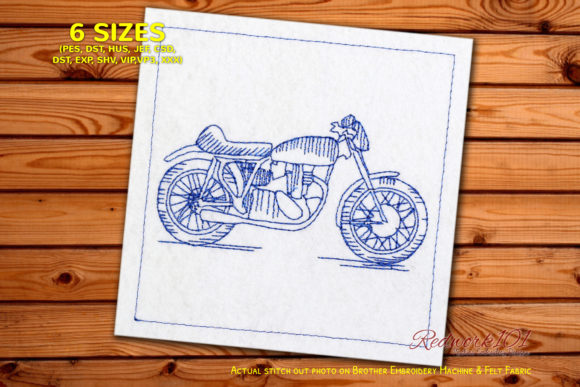
BSA Goldstar Clubman Redwork
A Craft Fair Designer’s First Look at This Vintage Ride
As an embroidery designer who’s prepped over 200 craft fair booths—from downtown pop-ups to rural farmers’ markets—I’ll tell you straight: Motercycle BSA Goldstar Clubman Redwork lands with confident charm. It’s not cute or whimsical—it’s bold, nostalgic, and quietly premium. The redwork style immediately signals handmade authenticity, while the BSA Goldstar Clubman silhouette taps into vintage transportation pride without leaning into cliché. No cartoon flames, no exaggerated chrome—just clean line work, intentional negative space, and that unmistakable mid-century British motorcycle profile. That makes it ideal for buyers who appreciate heritage design but reject kitsch.
Where It Shines on Handmade Market Products
This machine embroidery design excels where personality meets practicality. On a natural canvas tote bag? Instant focal point—especially when placed off-center near the bottom hem. On a heavyweight cotton apron? It reads clearly from six feet away, reinforcing a maker’s craftsmanship before they even speak. For tea towel embroidery, the redwork’s simplicity holds up beautifully against textured terry weave—no fear of lost detail in the loops. As an embroidered patch, it’s a conversation starter for motorcycle clubs, vintage gear shops, or retro lifestyle boutiques.
It’s equally strong on smaller items: a fabric pouch with Motercycle BSA Goldstar Clubman Redwork centered front feels giftable and intentional—not generic. Pillow covers benefit from its balanced proportions; the design doesn’t overwhelm, yet adds instant character to farmhouse or industrial-chic displays. And for caps? Only if stitched on structured front panels (not curved bill areas)—the lines are crisp enough to hold shape, but avoid tight curves unless you’ve tested density and tension first.
What Makes It Craft Fair-Ready (and Etsy-Listings Friendly)
This isn’t just a design—it’s a booth asset. At a glance, Motercycle BSA Goldstar Clubman Redwork communicates niche appeal without alienating. It draws motorcycle enthusiasts, history buffs, and design-savvy shoppers alike. Unlike overly literal or text-heavy motifs, it works as both a small accent (1.5” wide on a key fob) and large-scale statement (5”+ on a market bag). That versatility means fewer SKUs to manage—and more cross-selling potential.
Photography is effortless: red thread pops on cream, charcoal, olive, and navy fabrics. It renders cleanly in printable mockups, so your Etsy seller listings look cohesive and professional. And because the motif relies on outline and minimal fill, it’s highly repeatable across batch production—no worrying about inconsistent satin coverage or thread breaks mid-run.
Careful-Use Notes Every Embroiderer Should Know
- Dense stitch areas: If the “Box Stitch” border is included (per the description), confirm whether it’s decorative or structural—dense outer boxes can pucker lightweight fabrics. Skip it on tea towels or thin pouch linings unless stabilized properly.
- Tiny details & lettering: The Clubman name—if rendered in fine script—may blur below 2.5”. Test legibility at 1.75” on dark denim or textured twill before committing to cap or patch runs.
- Fabric texture matters: Avoid heavy embroidery on looped terry or thick quilted pillow covers unless you use cutaway + tear-away stabilizer combo. Thread can sink and mute contrast.
- Dark fabric warning: Redwork traditionally uses red thread on light fabric. On black or navy, verify thread contrast—some reds turn burgundy or brown under indoor fair lighting. Always test with your exact thread brand and fabric lot.
- Curved surfaces: Caps and contoured pouches require re-hooping or specialty hoops. Don’t assume the flat-stitch layout translates smoothly without a physical test.
How It Elevates Your Handmade Product Line
Motercycle BSA Goldstar Clubman Redwork doesn’t just decorate—it differentiates. In a sea of floral teacup motifs and generic “Live Laugh Love” embroidery, this design says curated, knowledgeable, intentional. It lifts perceived value: customers pay more for pieces that feel like collectibles, not commodities. For small shop products and boutique makers, it reinforces brand consistency—especially if paired with complementary motifs (vintage gears, enamel pin silhouettes, or typographic club slogans).
At the booth, it strengthens visual hierarchy. Place one embroidered tea towel folded beside a matching apron and a framed patch sample—you create a mini-narrative. Buyers don’t just see stitching; they see lifestyle. That drives engagement, longer dwell time, and higher cart values.
Pro Designer Checklist Before You Stitch
- Test the embroidery file on scrap fabric matching your final product—same weight, same dye lot.
- Check thread contrast under both daylight and warm fair lighting (halogen bulbs love to mute reds).
- Review spacing between elements—tight curves or intersecting lines may need manual digitizing tweaks for smooth travel.
- Confirm hoop size compatibility with your commercial embroidery machine and intended product dimensions.
- Inspect stitch density: redwork should be lean—not overfilled. Too many underlays = stiffness, especially on apparel.
- Match stabilizer to fabric: cutaway for knits, tear-away for stable wovens, fusible for lightweight linens.
- Create at least one real mockup—not digital only. How does it drape? Does the red thread catch light or look flat?
- Compare fabric colors side-by-side: oatmeal vs. unbleached canvas vs. stonewash denim all change how the red reads.
- Verify commercial licensing status before selling finished products—this is non-negotiable for Etsy sellers and wholesale partners.
Bottom line: Motercycle BSA Goldstar Clubman Redwork is a smart, scalable, emotionally resonant addition to any Transportation or Embroidery-focused handmade collection. It balances nostalgia with clarity, craftsmanship with commercial viability—and that’s exactly what moves units at 10 a.m. on a rainy Saturday at the craft fair.